NEW: Peptide Bioregulators for retina, blood vessel and pineal support (learn more)


If headlights throw more glare than they used to, or the print in a menu has gone soft in dim light, something in your lens has changed. A lot of what protects it is one vitamin.
Your eyes hold more vitamin C than almost any other part of your body. The clear fluid inside the front of each eye carries 20 to 70 times the concentration in your blood, and your eyes spend energy all day pumping it in to keep it that way. Inside the lens it absorbs UV light before that light reaches the lens proteins, keeps oxygen levels low, and recharges glutathione and vitamin E after they have done their work.
After 50, the level falls. Researchers measuring the fluid inside the eye found about 30% less in people over 70 than in people in their 50s. Your body can’t make vitamin C at all, so what reaches your eyes depends on what you eat and on a few habits you control.
What does vitamin C do in the eyes?
Vitamin C is the main antioxidant in the aqueous humor, the fluid that fills the front of your eye, and one of the two main antioxidants inside the lens, alongside glutathione. It absorbs UV light, keeps oxygen in the eye low, and neutralizes the free radicals that make lens proteins clump. It also restores spent glutathione and vitamin E to their active forms, and your body needs it to build the collagen in your cornea and in the walls of the retina’s blood vessels.
Which vitamin is best for eyes?
No single vitamin covers the whole eye. Vitamin A, made in your body from beta carotene, keeps the retina working in dim light, and a shortage causes night blindness and, if it goes on long enough, permanent vision loss. Vitamin E protects the fats in cell membranes. B vitamins, riboflavin among them, run the enzymes that recycle the eye’s antioxidants. Lutein and zeaxanthin build the macular pigment. Vitamin C is the one your eyes concentrate most heavily. In the AREDS trial, a formula of vitamins C and E with zinc and copper lowered the risk of advanced age-related macular degeneration by about a quarter in people already at high risk. A diet with all of them beats any one alone.
What happens when you start taking vitamin C every day?
Your blood level rises until your cells are full, which happens at roughly 100 to 200 mg a day. Above that, your kidneys clear the excess. The level in your eyes follows your blood level, so a steady daily intake from food does more for eye health than an occasional large dose. In one study, a 2,000 mg dose taken the day before eye surgery raised the level in the fluid inside the eye by 38%, measured the next day. The eye’s level follows the blood’s, so a rise lasts only as long as the blood spike does.
Do vitamin C eye drops really work?
Skin serums are cosmetics; this answer is about drops that go in the eye. Inside the eye, vitamin C works with glutathione and vitamin E: it recharges them after they neutralize free radicals. A drop that carries vitamin C with glutathione and N-Acetyl-Carnosine gives the lens all three at once. No drop replaces a diet that keeps your blood level up, because the lens draws most of its vitamin C from the aqueous humor, which your blood feeds.
Can too much vitamin C cause eye issues?
The safe upper limit for adults is 2,000 mg a day. Above that, the common problems are stomach upset and, in some people, kidney stones. For the eyes, a Swedish study that followed nearly 25,000 women for 8 years found that vitamin C supplement users had a 25% higher rate of cataract surgery, and women who had taken the supplements for 10 years or more had a 46% higher rate. At very high doses vitamin C can act as an oxidant instead of an antioxidant. Food-level intake carries none of these risks.
The aqueous humor holds 20 to 70 times as much vitamin C as your blood. Your blood carries roughly 50 micromoles per liter. The fluid in the front of your eye carries around 1,000. Researchers at the University of Auckland, reviewing decades of lens research in 2020, note that few tissues in the body hold more.
Getting it there takes work. A ring of tissue behind the iris makes the aqueous humor and pumps vitamin C into it. The lens then pulls the vitamin back out of that fluid, using two separate transporters, one for each of the two forms the vitamin comes in. Your body cannot make vitamin C at all, so all of it starts with what you eat. When your intake drops, your blood level drops, and the eye has less to pump.
Oxidative stress damages the lens over decades and sits behind most of the vision loss that comes with age. Vitamin C is one of the eye’s main antioxidants against it, and it protects the lens in four ways.
The lens isn’t the only part that depends on it. Vitamin C is present in your tear film, where it helps protect the surface of the eye against the oxidative stress of air, light, and screen time. It’s also what your body uses to build and maintain the collagen in the cornea, the clear dome at the front of the eye that holds its shape and does most of the focusing. Both jobs draw on the same supply the lens does, and both are affected when that supply runs low.
A 2015 study measured vitamin C in the aqueous humor of 74 adults and sorted the results by age. People in their 50s averaged 153 micrograms per milliliter, about 870 micromoles per liter. People in their 60s averaged 134. People over 70 averaged 107, about 30% below the youngest group, and the difference was statistically significant.
The lens itself loses the vitamin with age as well, and lower lens levels track with more advanced age-related lens changes. Three things drive the decline.
The proteins in the center of the lens were made before you were born and are never replaced, and the center is where glutathione runs lowest.
The National Eye Institute’s AREDS trial tested a formula built around vitamins C and E with zinc and copper in people already at high risk of age-related macular degeneration. Over roughly six years it lowered the risk of the disease progressing to its advanced stage by about a quarter. Vitamin C isn’t the whole story there, and the trial found no benefit for people without existing disease. It’s in the formula because the retina runs at a high metabolic rate and generates free radicals constantly. Vitamin C also builds the collagen in the walls of the retina’s blood vessels.
Citrus, tomatoes, and leafy greens add more. How you spread it across the day matters more than the total, because a steady blood level is what the eye’s pumps draw on.
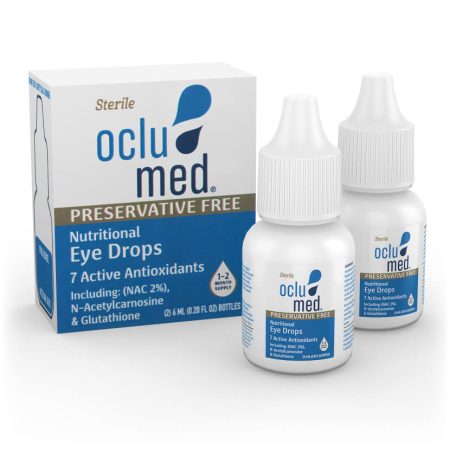
OcluMed® NAC Eye Drops contain 2% N-Acetyl-Carnosine, the highest concentration available, with ascorbic acid (vitamin C), L-Glutathione, L-Cysteine, L-Carnosine, L-Taurine, and Riboflavin (vitamin B2). Vitamin C is in the formula for the same reason it is in the eye: it recycles glutathione. Research on N-Acetyl-Carnosine shows it reduces lipid peroxidation in the eye. The formula is patented, preservative-free, and made in the US. Research on its active ingredients shows they reduce oxidative stress in the lens and support lens clarity as you age.
Nac-C Plus™ Capsules are the oral companion. Formulated by the inventors of the Can-C technology, they contain N-Acetyl-Cysteine, the best-studied oral precursor your body uses to make glutathione, and they extend the time the drops’ antioxidants stay active in the eye.
This is where a drop works differently from a tablet. A tablet raises the level in your blood, and the eye pumps from there. A drop goes onto the surface of the eye and is designed to deliver its antioxidants into the aqueous humor directly, the same fluid the lens draws from. It doesn’t replace eating well. That fluid is refilled continuously from your blood. It adds a second route into the fluid your lens actually feeds on.
Your eyes have been concentrating this vitamin since before you were born. After 50 they have less to work with, and most of what they get is up to you.
Lim, J. C., Caballero Arredondo, M., Braakhuis, A. J., & Donaldson, P. J. (2020). Vitamin C and the lens: New insights into delaying the onset of cataract. Nutrients, 12(10), 3142. doi:10.3390/nu12103142
University of Auckland review documenting the 20- to 70-fold vitamin C concentration in the aqueous humor, the SVCT2 and GLUT1 transport routes into the lens, its roles as UV filter, oxygen scavenger, and recycler of glutathione and vitamin E, and the case for dietary rather than high-dose intake.
Čanadanović, V., Latinović, S., Barišić, S., Babić, N., & Jovanović, S. (2015). Age-related changes of vitamin C levels in aqueous humour. Vojnosanitetski Pregled, 72(9), 823-826. doi:10.2298/VSP131212063C
Measured aqueous humor vitamin C in 74 adults and found a statistically significant decline from the 50s (153 µg/mL) to the 60s (134) to over 70 (107).
Hah, Y.-S., Chung, H. J., Sontakke, S. B., Chung, I.-Y., Ju, S., Seo, S.-W., Yoo, J.-M., & Kim, S.-J. (2017). Ascorbic acid concentrations in aqueous humor after systemic vitamin C supplementation in patients with cataract: Pilot study. BMC Ophthalmology, 17, 121. doi:10.1186/s12886-017-0515-2
Showed that a single 2 g oral dose raised aqueous humor vitamin C by 38% over controls, confirming that the eye’s level follows the blood level.
Giblin, F. J. (2000). Glutathione: A vital lens antioxidant. Journal of Ocular Pharmacology and Therapeutics, 16(2), 121-135. PMID 10803423
Establishes glutathione as the principal lens antioxidant and describes its working relationship with ascorbate in maintaining lens transparency.
Babizhayev, M. A. (2004). Lipid peroxidation and cataracts: N-acetylcarnosine as a therapeutic tool to manage age-related cataracts in human and in canine eyes. Drugs in R&D, 5(3), 125-139. PMID 15139774
Details N-Acetyl-Carnosine’s role in reducing lipid peroxidation in the aging eye.
Rautiainen, S., Lindblad, B. E., Morgenstern, R., & Wolk, A. (2010). Vitamin C supplements and the risk of age-related cataract: A population-based prospective cohort study in women. American Journal of Clinical Nutrition, 91(2), 487-493. PMID 19923367
Followed 24,593 Swedish women for 8 years and found a 25% higher rate of cataract extraction among vitamin C supplement users, rising to 46% with 10 or more years of use; the basis for the food-first advice above.
National Institutes of Health, Office of Dietary Supplements. Vitamin C: Fact sheet for health professionals. ods.od.nih.gov
Source for the RDA, the smoker adjustment, the 2,000 mg upper limit, the saturation and absorption figures, and the food content values.