August is National Eye Exam Month - click here for FREE healthy vision tips


The lens inside each of your eyes holds some of the highest concentrations of glutathione anywhere in your body, and it needs every bit of it. Glutathione keeps the proteins in your lens clear and protects them from the oxidative stress that builds up over decades of light exposure and normal metabolism. After age 50, that protection starts to slip. Glutathione production slows, the enzymes that recycle glutathione lose activity, and a physical barrier forms inside the lens that keeps fresh glutathione from reaching the center, exactly where it is needed most. Researchers call the result a glutathione deficit, and it is one of the most studied changes in the aging eye and in age-related vision decline. The good news: you can support your glutathione system through diet, lifestyle habits, and targeted nutrients.
Is glutathione good for the eyes?
Yes. Glutathione is the principal antioxidant in the lens of your eye, present there at some of the highest concentrations found in the body. It keeps lens proteins chemically reduced, which is what keeps them transparent, and it neutralizes hydrogen peroxide and other free radicals before they can damage lens tissue. Levels decline with age, which is why supporting the glutathione system matters more after 50.
Why do glutathione levels in the eye decline with age?
Three things happen at once. The lens produces less glutathione, the enzymes that recycle it back to its active form slow down, and around age 50 a barrier forms between the outer lens and its center that restricts fresh glutathione from diffusing inward. Researchers at the University of Wollongong documented this barrier in normal human lenses and identified it as a likely precondition for age-related lens changes.
How can I raise glutathione naturally?
Your body builds glutathione from three amino acids: glycine, glutamate, and cysteine. Cysteine is the one in shortest supply, so foods that provide it help most: garlic, onions, broccoli, Brussels sprouts, and quality protein. Vitamin C helps recycle glutathione back to its active form. Sleep supports production, and not smoking protects the supply you have.
Is glutamine the same as glutathione?
No, and the similar names cause real confusion. Glutamine is a single amino acid. Glutathione is a small protein your body assembles from three amino acids: glycine, glutamate, and cysteine. Glutamine contributes indirectly, since your body can convert it into glutamate, but glutamine supplements are not the same as supporting glutathione. For your eyes, glutathione is the one that matters.
Do glutathione eye drops work?
Plain glutathione drops face a delivery problem: the molecule degrades quickly and penetrates the eye poorly, so early clinical testing of glutathione-only drops showed little effect. Current research focuses on supporting the eye’s own glutathione system instead. That means precursors like cysteine and recyclers like vitamin C, which the lens uses to build and restore its own supply, plus antioxidants like N-Acetyl-Carnosine that reduce the oxidative load directly.
Glutathione keeps your lenses transparent. The lens has no blood supply, so it cannot draw antioxidants from the blood the way other tissues do. Everything it needs arrives through the aqueous humor, the clear fluid that fills the front of your eye, and glutathione carries most of the antioxidant workload.
The lens is built from tightly packed proteins called crystallins, arranged precisely enough for light to pass straight through. Free radicals make those proteins clump, and clumped proteins scatter light instead of transmitting it. Glutathione prevents that clumping, keeping crystallins in the clear, undamaged state.
It also neutralizes hydrogen peroxide, a byproduct of both metabolism and UV exposure that is constantly present in the aqueous humor, working with the enzyme glutathione peroxidase. A second enzyme, glutathione reductase, then recharges the spent glutathione so it can work again. Vitamin C, concentrated in the aqueous humor at levels far above those in your blood, works alongside this cycle, and research shows glutathione and vitamin C each extend the other’s antioxidant activity in lens cells.
The rest of your body depends on glutathione too. Your liver uses it for detoxification, your immune system relies on it, and researchers are studying its role in the retina, where low levels appear in studies of macular degeneration. The lens simply holds more of it than almost any other tissue, which is why aging eyes feel the loss first.
The decline has three causes, and they compound each other.
Daily life widens the gap. UV exposure raises oxidative stress in the lens and consumes glutathione. Smoking depletes it throughout the body. A diet short on sulfur-containing vegetables and quality protein leaves the lens without what it needs to make more.
The glutathione molecule is fragile. Swallowed as a dietary supplement, it is largely broken down in the digestive tract before it reaches your bloodstream, and its low bioavailability is well documented. Supplement makers have tried to work around this with liposomal glutathione, which wraps the molecule in a protective coating to survive digestion, but delivering meaningful amounts to the lens remains the unsolved step. Applied to the eye, glutathione degrades quickly and penetrates the surface poorly, and a 2024 review of lens research concluded that direct supplementation is limited by exactly these delivery problems.
Safety is the one thing not in question here: oral glutathione is well tolerated with few reported side effects. The obstacle is absorption.
The approach with better support is indirect: give the eye the materials and cofactors it uses to make and recycle its own glutathione. That means cysteine, the rate-limiting amino acid. It means vitamin C, which helps restore spent glutathione to its working form. And it means N-Acetyl-Carnosine, an antioxidant studied for its ability to reduce lipid peroxidation, the oxidative damage that degrades the fats in cell membranes, in the tissues of the eye.
The lens has always made its own glutathione. Supporting that process works with the eye’s own chemistry.
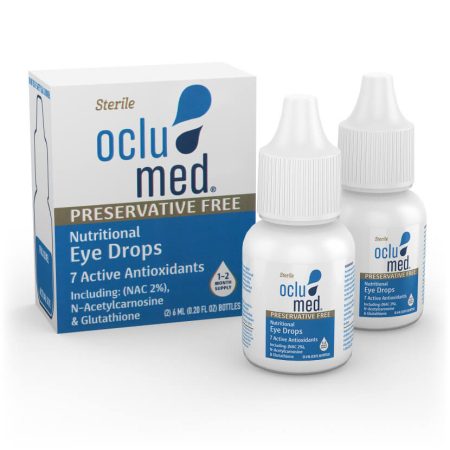
OcluMed® NAC Eye Drops were formulated around this pathway. Each drop delivers 2% N-Acetyl-Carnosine, the highest concentration available, together with L-Glutathione itself, L-Cysteine for the production pathway, Vitamin C for the recycling cycle, plus L-Taurine and Riboflavin. It is a patented, preservative-free, US-made formula built to reduce oxidative stress in the lens and support lens clarity as you age.*
For inside-out support, Nac-C Plus™ Capsules pair with the drops, and they connect directly to glutathione production. Formulated by the inventors of the Can-C technology, the capsules contain N-Acetyl-Cysteine, the best-studied oral precursor your body uses to make glutathione, along with L-Methionine, an amino acid your body converts toward cysteine. Oral N-Acetyl-Cysteine has been shown to support glutathione levels in eye tissue, working from the inside while the drops work from the outside. The capsules also extend the time the drops’ antioxidants stay active.*
If you prefer the original, clinically studied formula, Can-C™ Eye Drops are the 1% N-Acetyl-Carnosine drop with the longest track record of use, and our customer support team can help you choose between them at 1-800-861-4936.
Your lenses have been making their own glutathione since before you were born. After 50, they need more help than they used to. Give them the materials, and they know what to do.
*These statements have not been evaluated by the FDA. These products are not intended to diagnose, treat, cure or prevent any disease.
Giblin, F. J. (2000). Glutathione: a vital lens antioxidant. Journal of Ocular Pharmacology and Therapeutics, 16(2), 121-135. PMID 10803423
Review establishing glutathione as the principal antioxidant of the lens and detailing its role in maintaining lens transparency.
Sweeney, M. H., & Truscott, R. J. (1998). An impediment to glutathione diffusion in older normal human lenses: a possible precondition for nuclear cataract. Experimental Eye Research, 67(5), 587-595. PMID 9878221
Documented the age-related barrier that restricts glutathione movement into the lens center in people over about 50.
Lim, J. C., et al. (2024). Minimizing oxidative stress in the lens: alternative measures for elevating glutathione in the lens to protect against cataract. Antioxidants, 13(10).
2024 review concluding that direct glutathione supplementation is limited by delivery problems and evaluating precursor-based strategies for restoring lens glutathione.
Babizhayev, M. A. (2004). Lipid peroxidation and cataracts: N-acetylcarnosine as a therapeutic tool to manage age-related cataracts in human and in canine eyes. Drugs in R&D, 5(3), 125-139. PMID 15139774
Details N-Acetyl-Carnosine’s role in reducing lipid peroxidation in the aging eye.