NEW: Peptide Bioregulators for retina, blood vessel and pineal support (learn more)


If you’ve taken lutein, zeaxanthin or an AREDS2 formula for years and still struggle to read a menu in a dim restaurant, you’ve probably wondered whether anything else is out there. Peptide bioregulators are one answer people keep running into. They come from a long line of Russian research, much of it published only in Russian.
Do any peptides improve eyesight?
In the Khavinson clinic studies, most patients scored better on vision tests after courses of retinal and related peptides, usually given at the clinic and often by injection. Those patients were under a doctor’s care, and no supplement can promise the same results.
What is the best peptide for your eyes?
In the clinic research, the retinal peptide was part of the eye courses, usually with the blood vessel peptide and often the pineal peptide. If you’re starting with one, the retina bioregulator is the usual place to start.
Is the Retina Peptide Bioregulator the same as Visoluten?
Both are natural retinal peptide complexes based on Khavinson’s formulas. Visoluten is the Russian product; Nature’s Marvels makes its own version. Products from different makers aren’t identical, so compare labels.
Can I take them with Can-C™ or my other supplements?
Yes. Many of our customers take them alongside Can-C™ eye drops and their other supplements. If you take prescription medication, check with your doctor first.
How long before I notice anything?
Bioregulators are taken in courses over several months, starting with the 30-day course, then monthly courses for best results.
Peptides are short chains of amino acids, the building blocks of the protein you eat. Peptide bioregulators are very short ones, usually 2 to 4 amino acids, each matched to one tissue: the retina, blood vessels, the pineal gland, and so on. You’ll also see them called Khavinson peptides, after the scientist whose team developed them.
Bioregulators work as signals to cells. The Khavinson group reports that short peptides enter cells and help switch on the genes a tissue uses to make its own proteins (Khavinson et al., 2021). Professor Svetlana Trofimova, an ophthalmologist who worked with Khavinson for decades, says the peptides approach genes “as keys to locks.” She also stresses that they change how active certain genes are without altering the genes themselves.
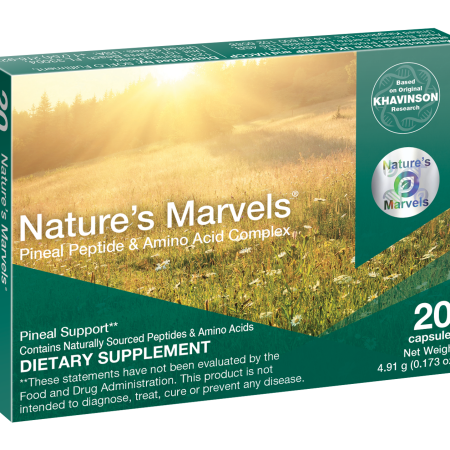
Peptide bioregulators come in two forms. Natural complexes are extracted from the matching tissue of animals and contain a mix of short peptides. Synthetic peptides are lab-made copies of a single short chain found in those extracts. Both come out of Khavinson’s research. Our Retina, Blood Vessel and Pineal bioregulators contain naturally sourced peptides and amino acids.
Professor Vladimir Khavinson began isolating tissue peptides at the Military Medical Academy in Leningrad in the 1970s. In 1992 he founded the St. Petersburg Institute of Bioregulation and Gerontology, and he published more than 700 papers on peptide regulation. His group worked with eye specialists at the Helmholtz Moscow Research Institute of Eye Diseases, and peptide preparations from his program entered clinical use in Russia.
Eye research was one of the program’s main lines. The group’s first results in the retina came in the mid-1980s with Retinalamin, a peptide complex from retinal tissue, and much of the later eye work was led by Professor Trofimova at the institute’s clinic.
In the lab. Retinal peptides helped retinal cells and the pigmented cells beneath them grow in culture, and the effect was specific to that tissue (Khavinson et al., 2003). In a 2013 study on developing retinal tissue, short peptides raised the markers of mature retinal cells (Khavinson et al., 2013).
In a controlled clinical study. In 2001, Trofimova and Khavinson reported on 104 people with diabetic retinopathy who received a course of retinal, pineal and cortex peptides, compared with 42 people who didn’t. The authors reported that visual acuity improved in 90% of the treated group, bleeding and swelling at the back of the eye cleared, and retinal function and blood flow improved in every treated patient, with no negative changes. The published summary doesn’t say how the 42 untreated patients did.
At the institute’s clinic. A 2011 report by Khavinson, Trofimova and Vladimir Neroev, director of the Helmholtz Moscow Research Institute of Eye Diseases, covered 1,500 patients treated between 1995 and 2010: 40% with macular degeneration, 30% with diabetic retinopathy, 23% with retinitis pigmentosa and 6% with other retinal conditions. Each had a full eye exam before and after their courses. The report says 95% had better results on vision tests and none got worse. One patient with diabetic retinopathy went from about 20/50 to about 20/25 vision over 11 ten-day courses.
The Khavinson institute’s 2011 clinic report includes individual patient records. Each patient had a diagnosed eye condition and took 10-day courses of a combination of bioregulators. The table shows the share of tested points in the field of vision that read as normal, before and after. These are single cases with no comparison group, not a controlled trial.
| Diagnosis | 10-day courses | Normal before | Normal after |
|---|---|---|---|
| Diabetic retinopathy | 11 | 51.3% | 93.7% |
| Retinitis pigmentosa | 12 | 8.5% | 29.6% |
| Age-related macular degeneration | 2 | 70.9% | 90.5% |
| Macular degeneration (transudative) | 6 | 92.6% | 96.8% |
| Chorioretinitis | 1 | 65.6% | 80.5% |
| Operated glaucoma | 11 | 14.3% | 56.6% |
Source: Khavinson V., Neroev V., Trofimova S., Osokina Yu., “Unique method for restoration of retinal functions in case of different diseases,” Saint Petersburg, 2011.
About this article: Wise Choice Medicine sells Nature’s Marvels peptide bioregulators. We wrote this article to explain the published research on peptide bioregulators and the eye. Most of that research used clinic courses, often injected and combined, that differ from the capsules sold as dietary supplements. This article is not medical advice and does not mean our products diagnose, treat, cure or prevent any disease. Talk to your eye doctor about your own eyes.
Looking back on 30 years at the clinic, Trofimova has said visual function improved in 80% of her retinal patients. In a 2020 study of 498 people with glaucoma, sensitivity on visual field tests rose after Retinalamin injections, while visual acuity didn’t change much (Erichev et al., 2020).
The retina depends on a dense layer of tiny blood vessels behind it for oxygen and nutrients. In the 2011 report, adding the blood vessel peptide to retinal courses was linked to stronger vessel walls, less leakage and faster clearing of small bleeds in the retina.
The same report says the peptides worked considerably better combined than used alone. In an animal study, the small blood vessels on the surface of the brain were more than a third less dense in older rats than in young ones. After a course of the vascular peptide, the network in older rats was 2.5 times denser than in untreated rats of the same age (Sokolova et al., 2016). That study looked at the brain, not the eye.
The pineal gland makes melatonin and keeps your sleep-wake cycle on time. It takes its cue from light reaching the retina, which is why it shows up in eye research at all. In animal studies, the pineal peptide complex raised the gland’s melatonin production (Khavinson, 2002). In the 2001 diabetic retinopathy study and the clinic courses above, the pineal peptide was part of the combination used alongside the retinal peptide.
The Khavinson research on these three peptides included:
Quite often, retinal disease involves some lack of blood supply. That’s why the Khavinson group added the blood vessel peptide to retinal courses: for the retina to recover, its blood supply has to be at its best.
Melatonin matters to the retina too. In a study of people with age-related macular degeneration, researchers looked at the effects of melatonin on the retina (Yi et al., 2005). Read our summary of the study.
Most of the clinical results above came from courses given at a clinic, often by injection, and usually with several peptides combined. Trofimova’s approach was 5 to 10 days of injections at the clinic, then capsules at home for the rest of a 25 to 30 day course.
The Khavinson group developed the capsule forms so people could take courses at home, and reported that their effect is comparable to the injections. That’s their finding, and it hasn’t been tested independently. Capsules are what’s sold as food supplements.
None of the clinical reports above recorded serious side effects. Safety testing reported by the Khavinson group found no serious reactions at single doses 5,000 times the normal amount, and no tissue changes in animals given 100 to 1,000 times the normal amount over long periods. Peptide bioregulators aren’t hormones, and they’re taken in courses of 10 to 30 days with breaks between.
Women who are pregnant or nursing shouldn’t take them. If you take prescription medication or hormones, check with your doctor first, and keep seeing your eye doctor.
The suggested schedule for our Retina, Blood Vessel and Pineal bioregulators:
Other brands use different strengths and schedules, so follow the directions on their label.
Our Peptide Bioregulators page explains how the retina, blood vessel and pineal bioregulators work together. They’re dietary supplements: the retina bioregulator supports retinal function, visual clarity and low-light vision, the blood vessel bioregulator supports healthy circulation, and the pineal bioregulator supports a healthy sleep-wake cycle.*


Khavinson, V. K., Popovich, I. G., Linkova, N. S., Mironova, E. S., & Ilina, A. R. (2021). Peptide regulation of gene expression: A systematic review. Molecules, 26(22), 7053. PMID 34834147
Khavinson, V. K., Zemchikhina, V. N., Trofimova, S. V., & Malinin, V. V. (2003). Effects of peptides on proliferative activity of retinal and pigmented epithelial cells. Bulletin of Experimental Biology and Medicine, 135(6), 597-599. PMID 12937684
Khavinson, V. K., Pronyaeva, V. E., Linkova, N. S., & Trofimova, S. V. (2013). Peptidergic regulation of differentiation of embryonic retinal cells. Cell Technologies in Biology and Medicine, 1, 57-60.
Trofimova, S. V., & Khavinson, V. K. (2001). Effectiveness of bioregulators in the treatment of diabetic retinopathy. Vestnik Oftalmologii, 117(3), 11-14. PMID 11521426
Khavinson, V. K., Neroev, V. V., Trofimova, S. V., & Osokina, Y. Y. (2011). Unique method for restoration of retinal functions in case of different diseases. Saint Petersburg Institute of Bioregulation and Gerontology and Helmholtz Moscow Research Institute of Eye Diseases.
Erichev, V. P., Lovpache, D. N., & Yaremenko, T. V. (2020). Peptide bioregulators: Delivery and efficacy. Vestnik Oftalmologii, 136(2), 56-62. PMID 32366071
Sokolova, I. B., Ryzhak, G. A., Mel’nikova, N. N., Sergeev, I. V., & Khavinson, V. K. (2016). Effects of vascular peptide bioregulator on the density of microvascular network in the brain cortex of aged rats. Bulletin of Experimental Biology and Medicine, 161(2), 300-303. PMID 27383168
Khavinson, V. K. (2002). Peptides and ageing. Neuroendocrinology Letters, 23(Suppl 3), 11-144. PMID 12374906
Yi, C., Pan, X., Yan, H., Guo, M., & Pierpaoli, W. (2005). Effects of melatonin in age-related macular degeneration. Annals of the New York Academy of Sciences, 1057, 384-392. doi: 10.1196/annals.1356.029
Trofimova, S. V. (2020). Peptide bioregulators and vision [Interview]. International Antiaging Systems. Read the interview